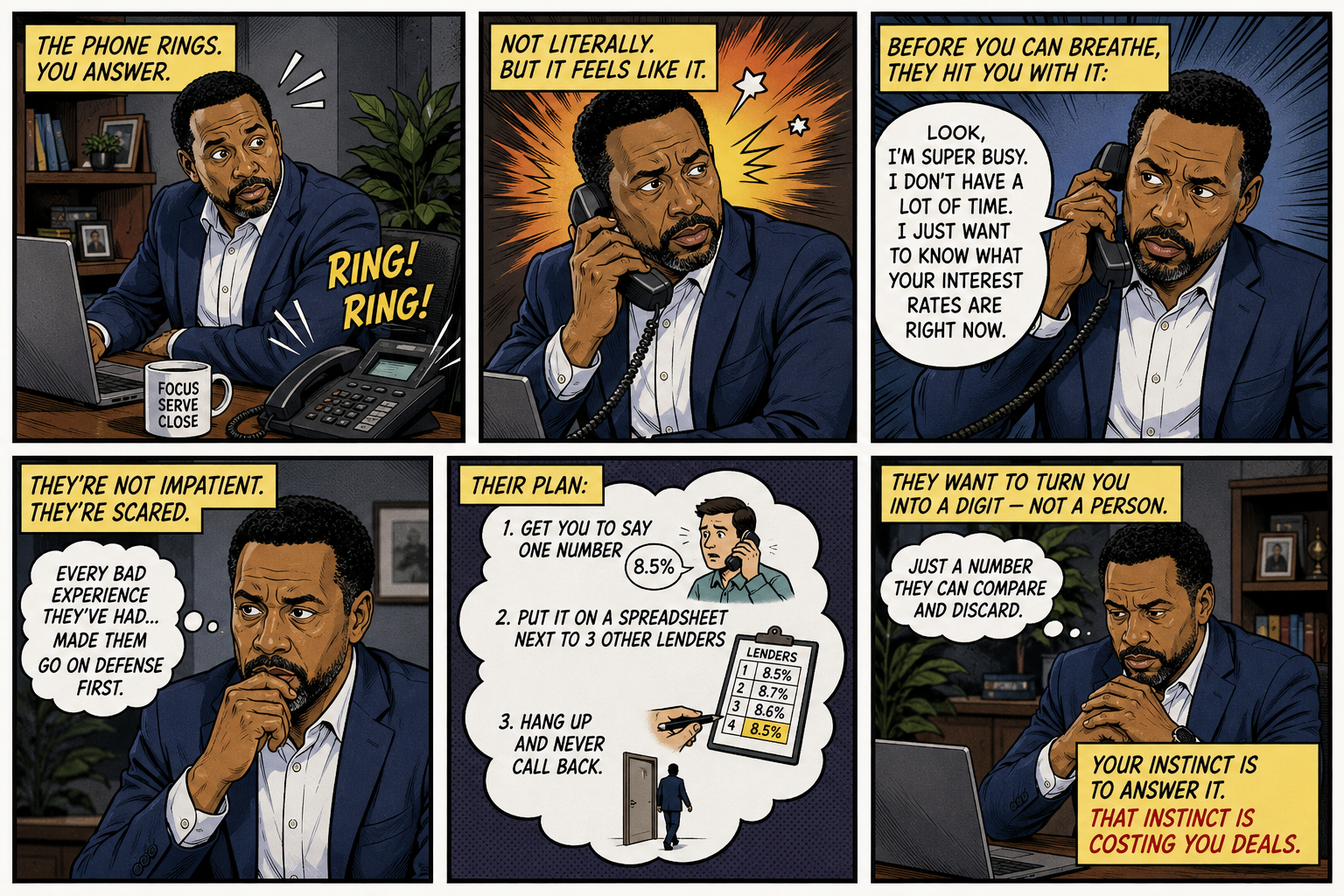
The phone rings. You answer. The first thing they say throws you off.
Not a great feeling. But it happens on almost every call — and once you know what's really going on, you'll know exactly what to do.
You pick up. You haven't even finished saying your name. Before you can breathe, they say:
Prospect"Look, I'm super busy. I don't have a lot of time. I just want to know what your interest rates are right now."
That's called a brick wall statement. Your instinct is to answer it. That instinct is costing you deals.
Before we dive in
Every call follows the same 8 stops.
This is the structure of a DSCR call from the first word to a submitted application. Each stop has a job. When you know what stop you're on, you always know what to do next — and you never get lost.
This course trains Stop 1. The other stops each get their own course. Tap through to get your bearings.
The psychology
They're not impatient. They're scared.
They know a salesperson is about to call. Every bad experience they've had — the pushy car dealer, the person who wouldn't let them hang up — trained them to go on defense first.
Their plan:
① Get you to say one number
② Put it on a spreadsheet next to 3 other lenders
③ Hang up and never call back
They want to turn you into a digit — not a person. Just a number they can compare and discard.
The psychology continued
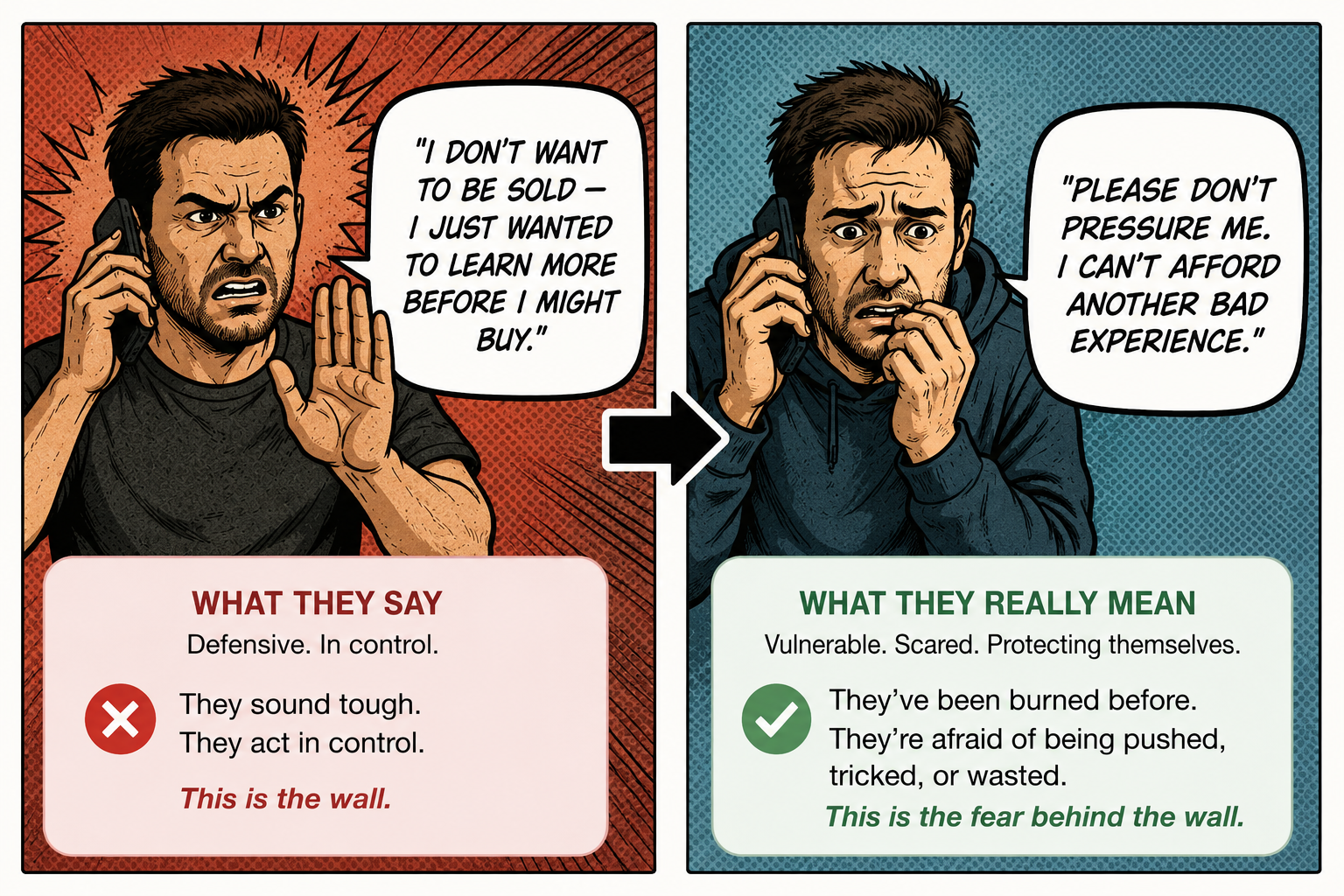
What they say vs. what they actually mean.
"I don't want to be sold — I just wanted to learn more before I might buy."The Conversion Code — Chris Smith
They're not rude. They're defensive. Big difference.
They expect you to cave. Every other lender did. Your job is to be the one who doesn't.
💡
Quick check-in
The prospect isn't angry. They're afraid of being sold to. That fear is running the first 30 seconds of every call.
That's the psychology. Hold onto it — it changes how every call feels.
What the mistake looks like
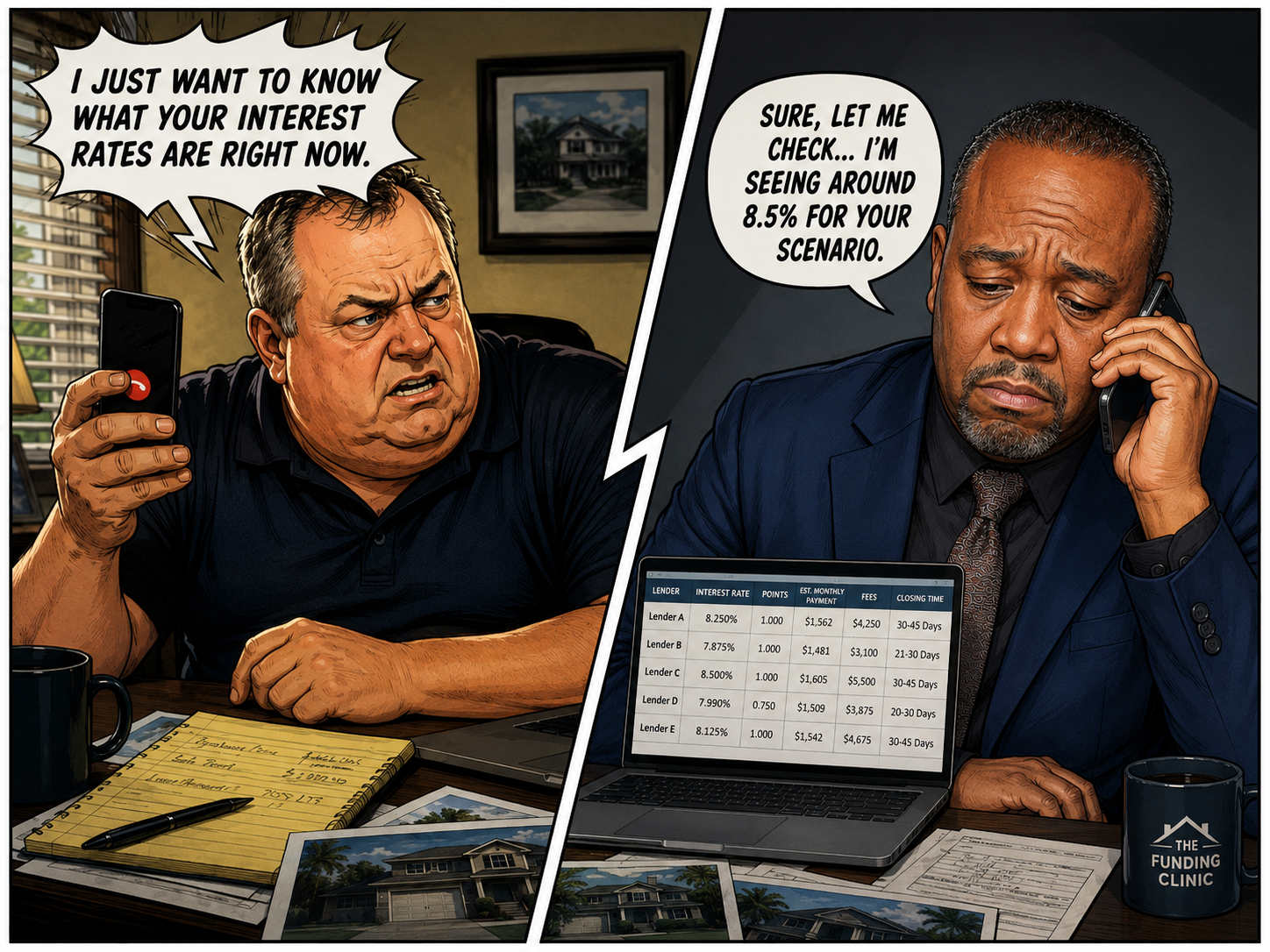
This is what caving looks like — so you can spot it and stop it.
Real scenario — the wrong response
Prospect"I just want to know what your interest rates are right now."
Terrance"Sure, let me check... I'm seeing around 8.5% for your scenario."
Prospect"Okay. Thanks. I'll think about it."
✕ Click. Gone. Dead on arrival.
They got the number. They know nothing about the 14-day close, no tax returns, or deals you close when banks say no. They have a number — and nothing else.
The Iron Rule
Why the number always feels too expensive.
Price first
8.5%
→
Result
Always feels too high
Think of a doctor who hands you a $3,000 bill before examining you. You'd walk out.
But if they run tests, explain the problem, and show you why the treatment is right — $3,000 feels worth it.
You're in the same business. The rate is the prescription price. They need the diagnosis first.
↪ Continued from The Iron Rule
Value before price — in action
Same rate. Completely different reaction.
Most lenders give the number first. You give them a reason to say yes — then the number.
✕ Wrong — price first
Prospect"What's your rate?"
Terrance"We're around 8.25% on a 30-year DSCR right now."
Prospect"That seems high. I saw 7.5% online."
✕ Now you're defending instead of selling.
✓ Right — value first, then price
Terrance"Here's what this loan actually does for you — no tax returns, no W-2s, no income verification. The property qualifies itself on rent. We close in 14 days. I've closed deals every conventional bank turned down."
Terrance"Given all that — the rate is 8.25%. Does that make sense for where you're trying to go?"
Prospect"Yeah — I've been trying to get this done for 3 months. When can we start?"
✓ Same rate. Value anchored it. Completely different reaction.
The rate didn't change. What changed is they now have something to attach it to.
⚡
Remember this
Price before value = price always feels too high. Always. No exceptions.
This is the principle the whole framework is built on. Now you'll see the framework itself.
The framework
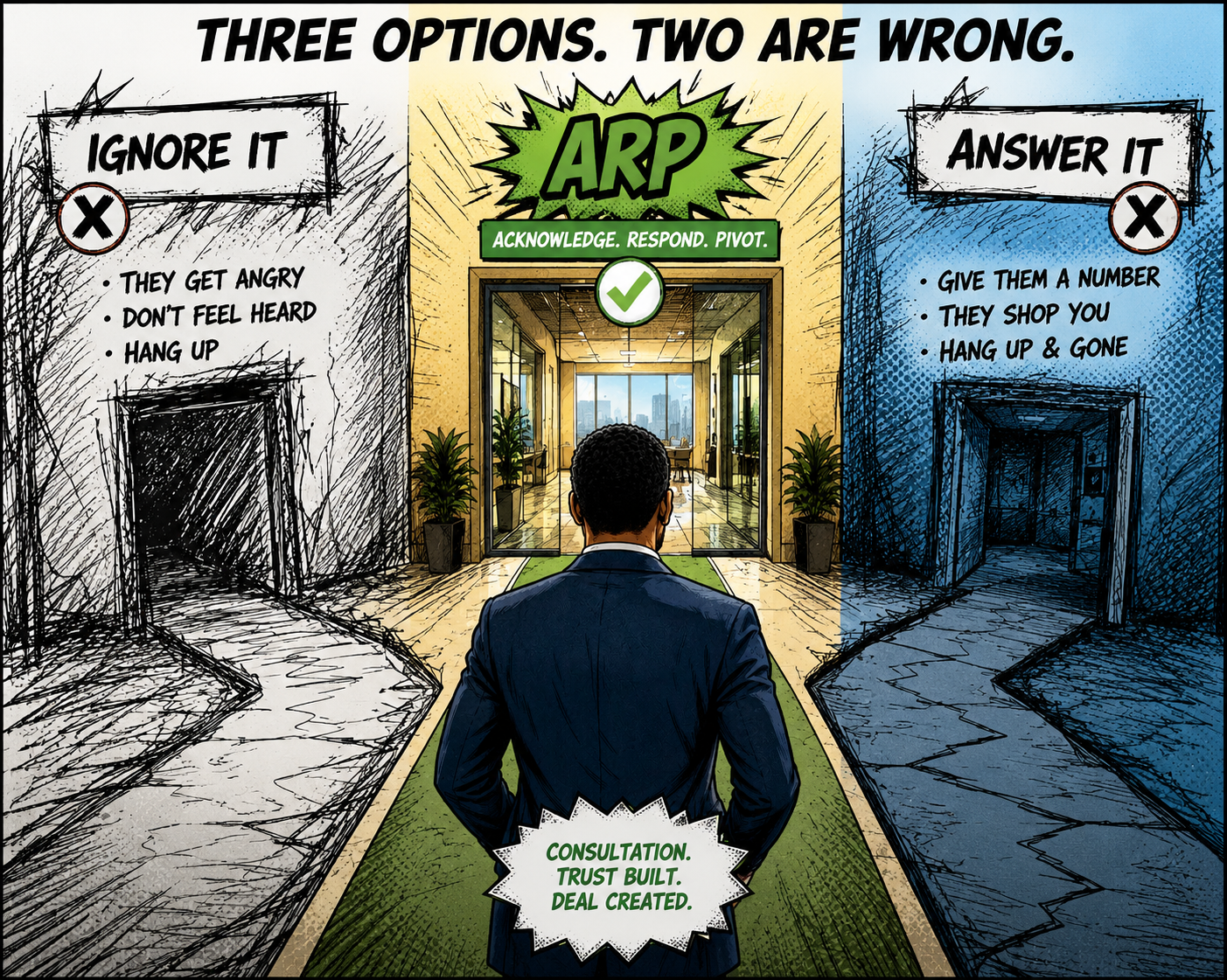
Three options. Two are wrong.
✕ Ignore it — they hang up angry
✕ Answer it — they hang up satisfied. And gone.
✓ ARP — the third path that keeps them on the line
ARP = Acknowledge, Respond, Pivot. Not a script. A reflex.
ARP — Step 1 of 3
Acknowledge
This one sentence does more work than it looks like. Most salespeople blow right past it because they're eager to pitch. But skipping it means the prospect feels invisible before you've said anything useful — and invisible people hang up.
A
Acknowledge
Repeat back exactly what they said. On the phone there's no body language. This is your head nod. Skip it and they feel invisible.
"You want to know the rates — no problem at all."
One sentence. Tells them you heard them. Buys you the next 10 seconds.
▶The Acknowledge line is: "You want to know the rates — no problem at all." Say it once out loud right now. You just did your first rep.
▶It needs to sound like something you'd say — not like a line you memorized. The tone matters as much as the words. Relaxed. Unhurried. Confident.
ARP — Step 2 of 3
Respond
Here's the pattern this step breaks: they ask for the rate, you give it, they hang up. Respond holds the promise — the rate is coming — without surrendering it before you know if you can even help them.
R
Respond
Give a brief honest answer that keeps the promise without giving the number. You're not dodging — you're saying the answer is coming once you know you can help.
"I'm going to cover all the pricing on this call — that's the whole reason we're talking."
You're not lying. The answer IS coming. Just not before the diagnosis.
▶The Respond line is: "I'm going to cover all the pricing on this call — that's the whole reason we're talking." It's honest, it's calm, and it keeps the promise.
▶You are not dodging. You are sequencing. There's a real difference — and most salespeople never learn it.
ARP — Step 3 of 3
Pivot
This is where you take the wheel. Your instinct is to keep explaining product. Wrong move. Ask about their situation and you're suddenly running the consultation.
P
Pivot
Ask one discovery question. One. Move the conversation toward their situation. The dynamic shifts completely.
"Are you looking to buy a new property or pull cash out of one you already own?"
▶"Are you looking to buy a new property or pull cash out of one you already own?"
▶"How much equity are you sitting on in that property right now — ballpark?"
▶"Are you trying to close fast, or do you have some runway?"
▶"Is this your first DSCR deal or have you done this before?"
▶"What's the rental income on that property right now?"
They stop being a rate shopper. They start describing their deal. You're now the consultant.
🎯
The full picture
Acknowledge → they feel heard. Respond → trust stays intact. Pivot → you're back in control.
Three moves. One outcome: the call continues.
You just learned the framework. Next you'll see it work on a real call.
ARP in action
Same wall. Watch what changes.
ARP applied
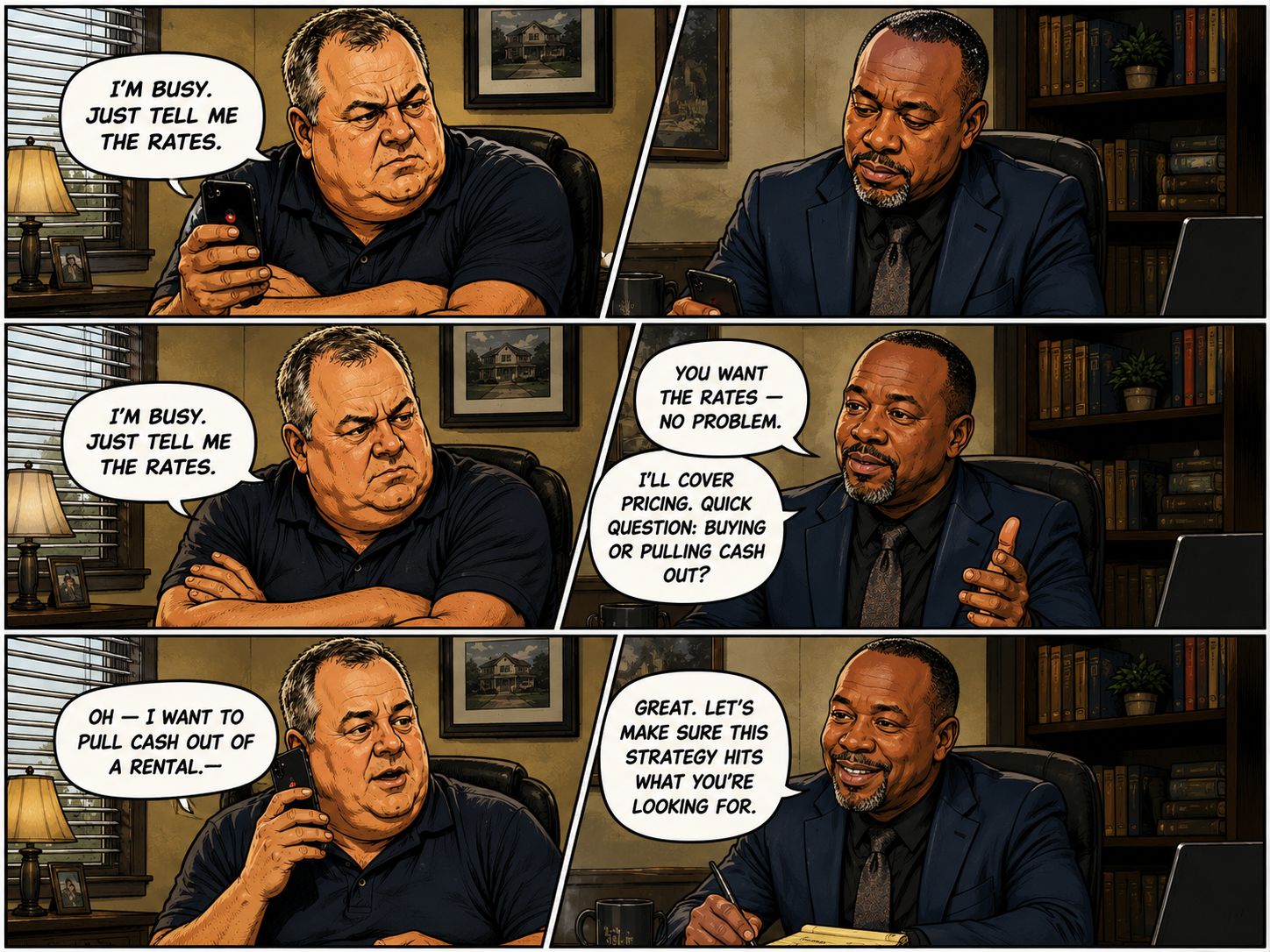
Prospect"I'm busy. Just tell me the rates."
Terrance (A)"You want to know the rates — no problem at all."
Terrance (R)"I'm going to cover all the pricing on this call — that's exactly why we're talking."
Terrance (P)"Quick question — are you looking to buy or pull cash out of something you already own?"
Prospect"Oh — I want to pull cash out of a rental."
✓ Wall down. Consultation started.
They answered. They stopped being a rate shopper. That's ARP working.
↪ Continued from ARP in action
When they push back after your Pivot
They doubled down. Here's exactly what to do.
Most salespeople cave here. This is where you separate yourself.
Attempt 1 — try once more, calmly
Prospect"Just tell me the rate."
Terrance"I hear you — and I will get there. I just need 60 seconds to make sure I'm quoting you the right product, because the rate depends on your specific situation. Real quick — buying or pulling cash out?"
Attempt 2 — strip it down to one number
Prospect"I just want the rate. That's all I need."
Terrance"Give me one number — how much are you looking to pull out?"
Three refusals = permission to move on. Exit politely. If they won't answer one question, they won't give you their card 20 minutes later. Moving on isn't a failure — it's how you protect your time for the buyers who are actually there.
Most prospects break on the second attempt. The ones who don't were never real leads.
⚛ Practice tips
Why this works — and how to build the reflex
The psychology behind ARP. And what to drill before your next call.
▶When you Acknowledge, the prospect's brain registers: they heard me. The defensiveness drops slightly. That half-second is your opening.
▶The Pivot works because it forces them to think about their own deal — not about comparing you to other lenders. You broke their script.
▶Prospects who answer a discovery question are significantly more likely to continue the call. One answer means they've invested. Investment creates momentum.
1Say the Acknowledge line out loud right now — once: "You want to know the rates — no problem at all." That's the first rep. It doesn't have to feel smooth yet. Smooth comes with repetition, and you just started.
2Pick one default Pivot question for DSCR calls and lock it in. Know exactly what you're going to ask before you pick up the phone.
3Slow down between R and P. A brief pause before the Pivot reads as confidence — not hesitation. Most salespeople rush it and lose the effect.
ARP isn't a script. It's a reflex. Reflexes are built by repetition — not by reading.
Real call — the wall Terrance never crossed
What Cheryll actually said. And what Terrance did.
Cheryll didn't ask about rates. She opened with something harder.
The Cheryll call — first words
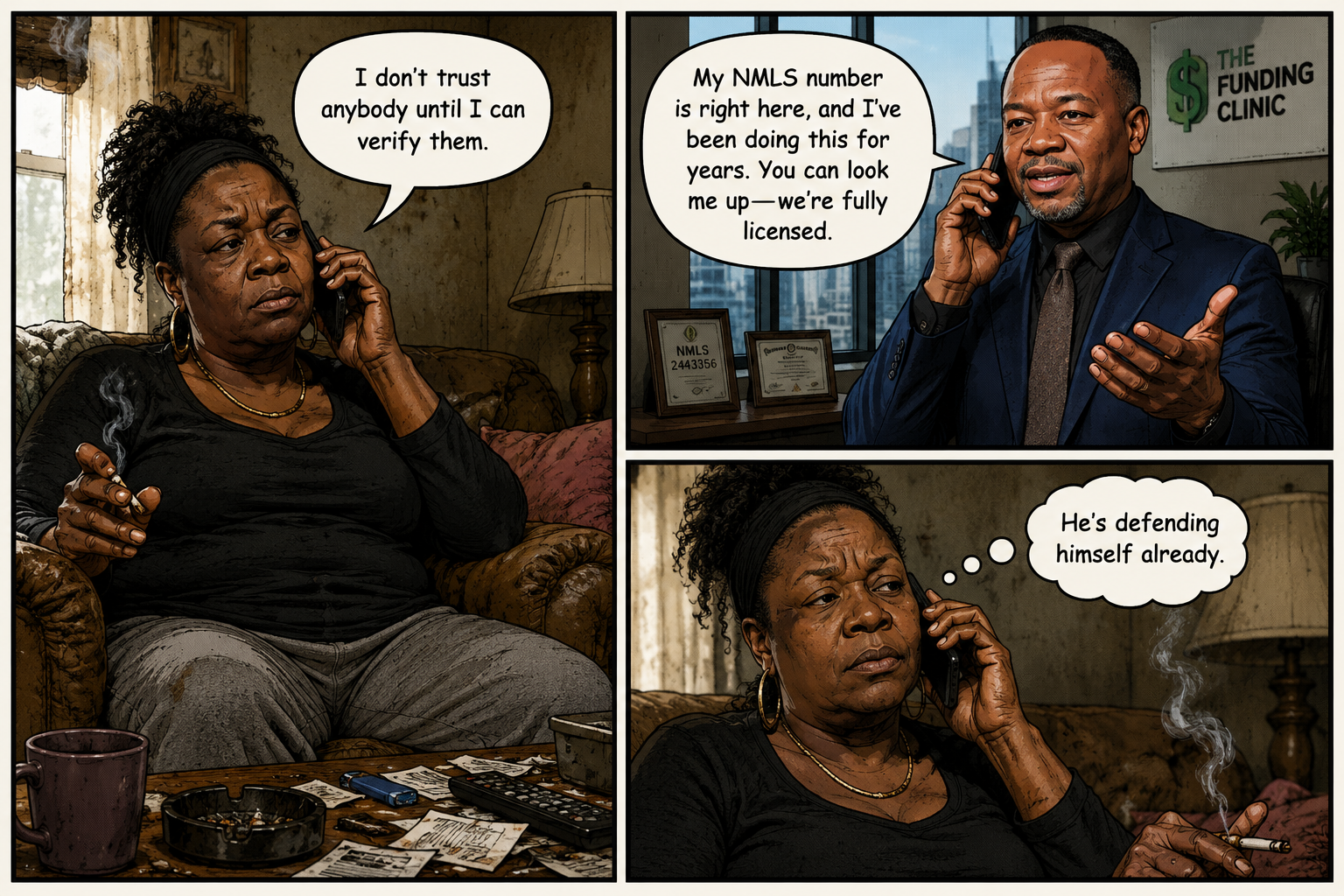
Cheryll"I don't trust anybody until I can verify them."
Terrance"Sure — my NMLS number is... and I've been doing this for years... you can look me up on the NMLS website... we're a fully licensed brokerage..."
What happened next: Terrance spent several minutes on defense — proving he was real, answering every challenge, letting Cheryll run the entire call. He never regained control. He never asked a single qualifying question. He didn't find out the loan amount until the second call.
He accepted the role of suspect. He should have been playing the role of expert.
Real call — ARP on a paranoia wall
Same wall. Same ARP. Done in 90 seconds.
ARP isn't only for rate shoppers. It works on any wall — paranoia, suspicion, aggression. The mechanic is identical.
How it should have gone
Cheryll"I don't trust anybody until I can verify them."
Terrance (A+R)"You want to verify exactly who you're doing business with — that's incredibly smart. My NMLS number is at the bottom of the email I just sent you."
Terrance (P)"Now — to make sure I respect your time, roughly how much cash are you looking to pull out today?"
Cheryll"Well... maybe just $6,000. I have a chipmunk problem..."
✓ Done in 90 seconds. Minimum is $100k. Politely exit. Move on to real deals.
One Pivot question in the first 60 seconds saves hours. Either it's a deal or it isn't. Find out fast.
🎧
Listen to the full breakdown
Deep dive on ARP and brick wall psychology with real call examples. About 15-20 minutes. Don't skip — the test will know if you did.
Prospects wall up because they're afraid of being pressured — not because they're rude.
2
Answering immediately kills the deal — they have everything they need to hang up.
3
Acknowledge — repeat back what they said. The phone head nod.
4
Respond — brief honest answer, no number. Trust stays intact.
5
Pivot — one discovery question. You take the wheel.
6
Value first, price second. The rate is the same either way — what changes is whether they have something to anchor it to.
The test is just three questions in your own words. There's no trick — write what you understood and the AI will work with you from there.
The Funding Clinic — Phase 1 Test
Show what you absorbed.
Three questions in your own words. Write what landed — not what you memorized. Score 4 or higher on each, plus two follow-up questions. Then you're done.
Progress
0 of 3 complete
1
When a prospect throws up a brick wall, what are they actually afraid of?
Not what they say — the fear underneath it.
2
What does Acknowledge, Respond, and Pivot mean — and what does each step actually do?
All three steps. Explain the purpose of each, not just the definition.
🔒 Unlocks after you pass Question 1
3
Why does answering immediately ruin the deal and make you an order taker?
Walk through what happens step by step — why does giving the number end the call?