‹ Suite
The Funding Clinic — Phase 3
1 of 35
~30 sec
The Wound

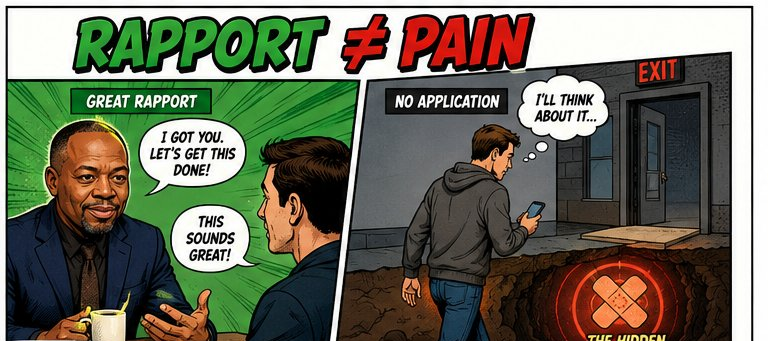
Rapport is not pain.

The goal is not a "good conversation." The goal is to find the reason they cannot stay where they are.
Illustration: Rapport vs pain — great rapport but no application
img/phase3/slide01_rapport_vs_pain.png

You can make people like you. That is not the same as making them move.

A warm call can still end with no application if you never uncover the consequence they are trying to escape.

Phase 3 is about finding the wound — the pain strong enough to make the borrower move today.
The real problem

You keep stopping at the surface.

The request tells you what they want. The wound tells you why they will move.

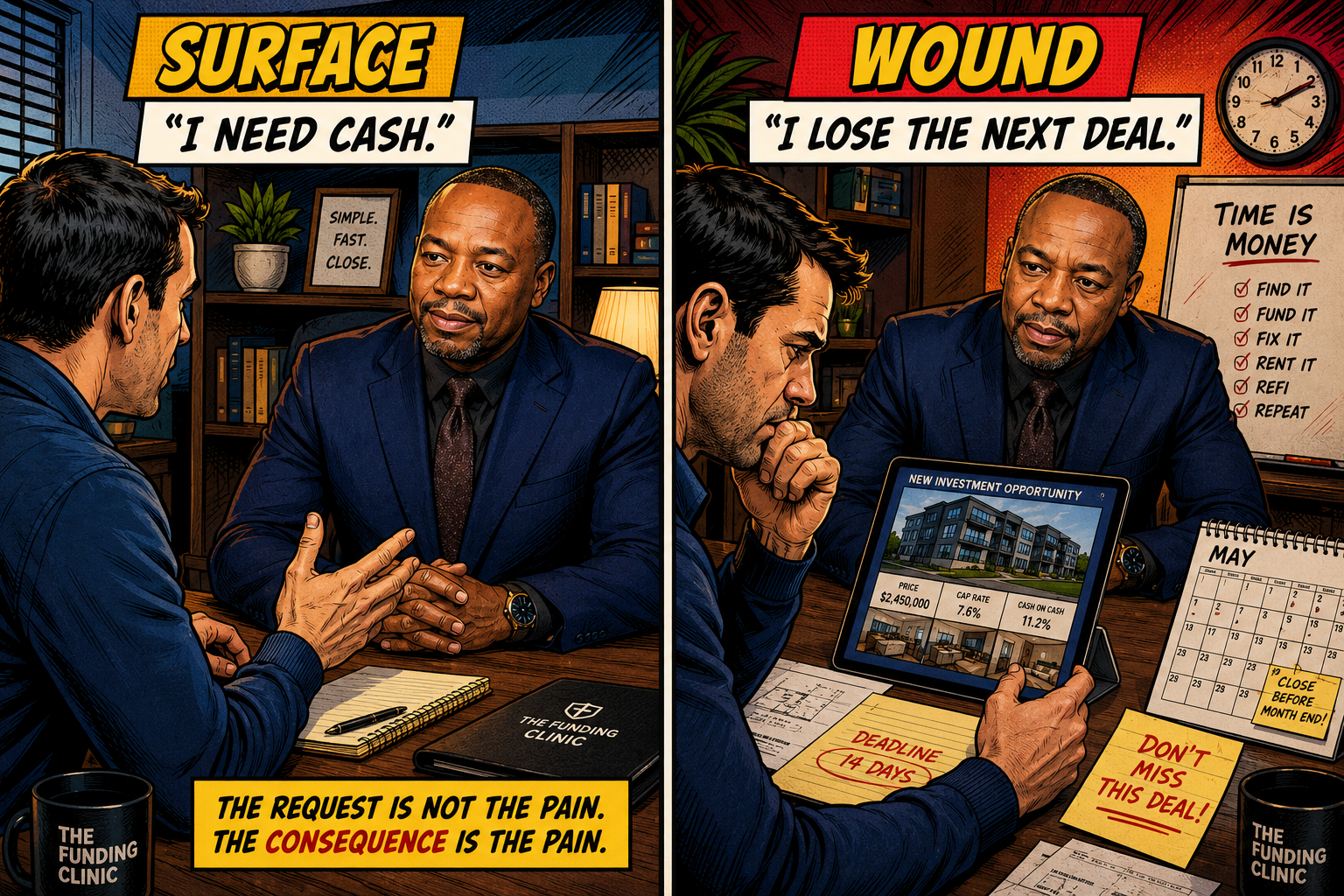
A prospect says, "I want to pull cash out." That is not the wound. That is the request.

Surface
"I need cash."

This tells you the product category.

Wound
"I lose the next deal."

This tells you why they should move now.

Terrance blind spot: You hear a clear request and think, "Great, I know the product." But the product is not the close. The pain is the close.
The 5th-grader definition

Pain is the consequence.

When the consequence is clear, urgency stops feeling forced.
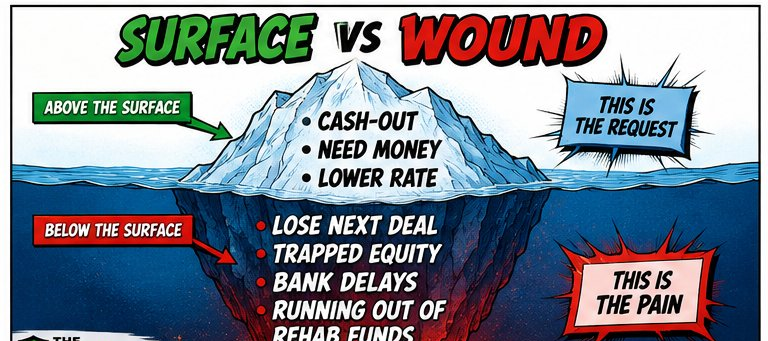
Illustration: Surface vs wound — iceberg diagram
img/phase3/slide03_surface_vs_wound.png

Pain is not "I need money." Pain is what happens if the money does not show up.

Request Consequence Urgency
Pain formula
Surface: I need cash → Wound: If I do not get it, I lose the opportunity → Move: Start the application.
The wound is the consequence. No consequence, no urgency. No urgency, no application.
🩺
Lock this in
Do not pitch the loan until you know what hurts.
Hit Next.
The Dig

Every answer gets one more question.

One extra question can turn a quote shopper into a real borrower.
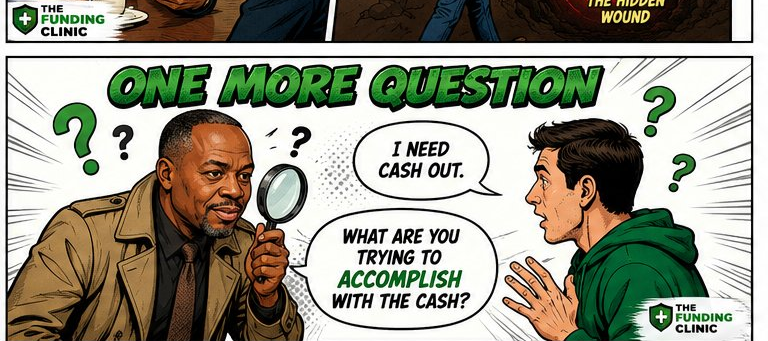
Illustration: One more question — what are you trying to accomplish with the cash?
img/phase3/slide05_one_more_question.png

The phrase that kills your depth is "perfect." It sounds supportive, but it ends the thread.

Old reflex
"Perfect."

Ends the thread and moves to the next fact.

New reflex
"What makes that important right now?"

Keeps the thread open and finds urgency.

Every answer gets one more question.
Surface vs wound

Cash-out is the surface. The reason is the wound.

The money is not the story. The plan for the money is the story.
Illustration: Surface need versus hidden wound
img/phase3/slide06_surface_vs_wound.png
The difference
Prospect "I want to pull cash out."
Terrance "Got it — what are you trying to accomplish with the cash?"
Prospect "I found another property and I cannot move without the equity."
Now you are not selling a loan. You are helping them avoid missing the next deal.
Problem questions

Start with what they are trying to fix.

Use these when you still do not understand the situation.

Problem questions locate the issue. They turn a loan request into a business situation.

What are you trying to accomplish with the cash?
How long have you been trying to get this done?
What happened with the bank?
What is this money supposed to help you do?
Bank this line
"What are you trying to accomplish with the cash?"
Implication questions

Then ask what happens if they do not solve it.

Use these when you need to create urgency without pressure.
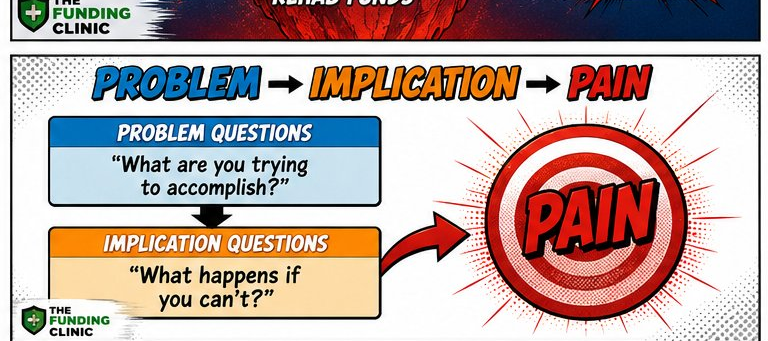
Illustration: Problem to implication to pain flowchart
img/phase3/slide08_problem_implication.png

Problem questions find the issue. Implication questions find the consequence.

What does this delay cost you?
Are you at risk of losing the property?
What happens if the bank says no again?
How long can you keep waiting before this becomes a problem?
Implication questions create urgency without you sounding pushy.
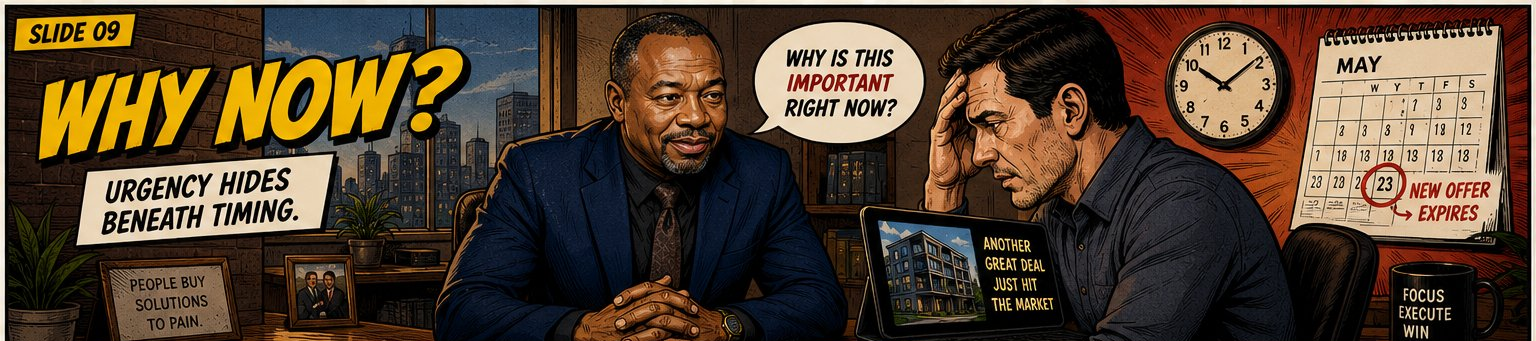
The "why now" question

The fastest way to find urgency is to ask why now.

Timing reveals whether they are browsing or trying to solve something.
Illustration: Why-now question reveals urgency
img/phase3/slide09_why_now.png

Timing reveals pain. If there is no timing pressure, the deal can drift. If there is a deadline, your job is to uncover it.

Terrance "Why is this important right now?"
This one question tells you whether they are curious or motivated.
🔎
The Dig
The wound is usually one question deeper than where you stopped.
Keep going.
Game Film

The call sounded good, but the wound stayed hidden.

A call can sound productive and still fail if it never reaches consequence.

Some calls feel productive because you gathered a lot of facts. Property type. Value. Rent. Loan amount. Credit. Timeline.

But facts only explain the file. Pain explains why they should submit the application today.

A file with facts but no wound is easy to ghost.
What Terrance asked

Surface questions collect the file. They do not create movement.

File questions matter. They just do not carry the close by themselves.
3
File facts

Value. Balance. Rent. Loan amount.

0
Consequences

No urgency. No reason to act today.

Surface-only call
Property value + mortgage balance + cash-out target does not equal motivation.

Those questions matter. They just cannot be the whole call.

↳ What should happen
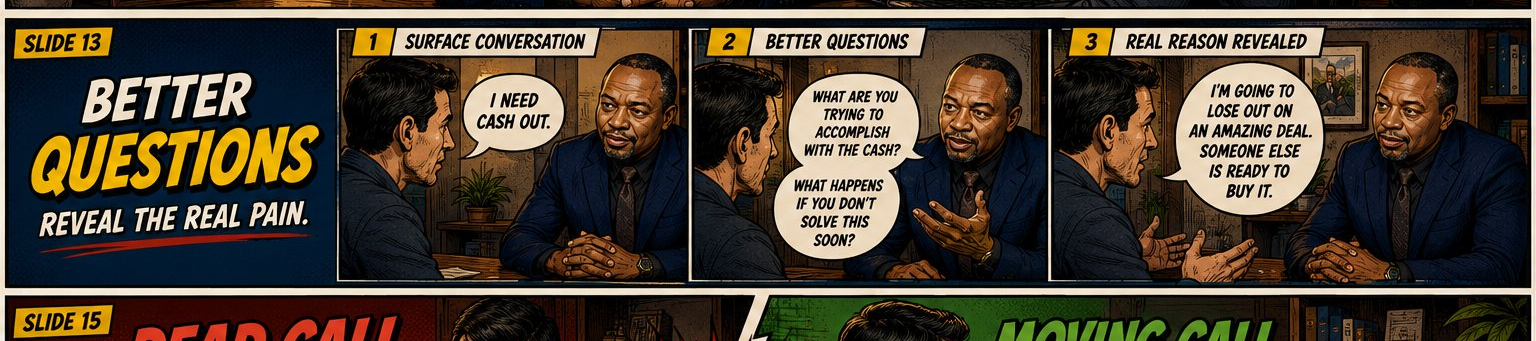
Rewrite the moment

One layer deeper changes the call.

Attach every file fact to a consequence question.
Illustration: Better questions reveal the real pain
img/phase3/slide13_better_questions.png
Terrance "What are you trying to accomplish with the cash?"
Terrance "What happens if you cannot access it in time?"
Terrance "Why does this need to happen now instead of six months from now?"
✓ Now you have urgency, not just numbers.
Do not abandon file questions. Add consequence questions right behind them.
Real Call Win

Submitted-app calls have a reason to move.

When motivation is clear, the application feels like the next logical step.

The pattern in stronger calls is simple: the prospect is not just interested in money. They are trying to solve something specific.

When the reason is clear, the application becomes the next step instead of a favor you hope they do later.

A submitted application usually has a wound behind it.
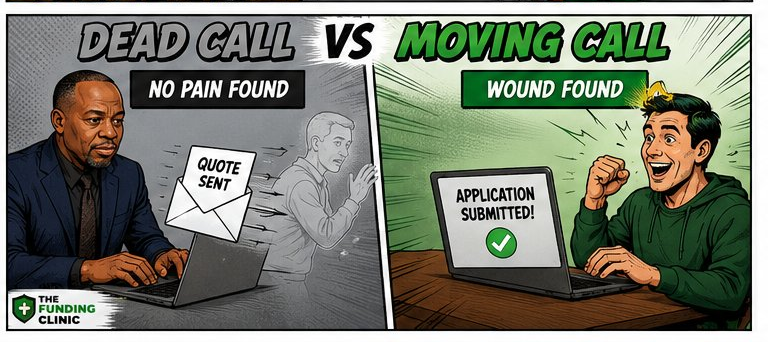
Compare the two

Dead calls have facts. Moving calls have pain.

Same rapport. Different outcome. The difference is urgency.
Illustration: Dead call vs moving call — no pain found vs wound found
img/phase3/slide15_dead_vs_moving.png
Dead Call
Facts only

Property facts. Quote sent. "Look it over." No urgency. No application.

Moving Call
Facts + pain

Pain found. Consequence named. Product prescribed. Application requested.

Check-in

Which question finds the wound?

Prospect says: "I want to pull some equity out of my rental."
Best next question?
🧠
Game Film Lesson
Facts explain the file. Pain moves the borrower.
Hit Next.
Pain → Pitch

Once you find the wound, the pitch writes itself.

Pain turns your pitch from explanation into prescription.

Without pain, you are explaining products. With pain, you are prescribing a cure.

Delay pain
Pitch speed

They need movement.

Tax-return pain
Pitch simplicity

The property tells the story.

Opportunity pain
Pitch equity access

Unlock the next deal.

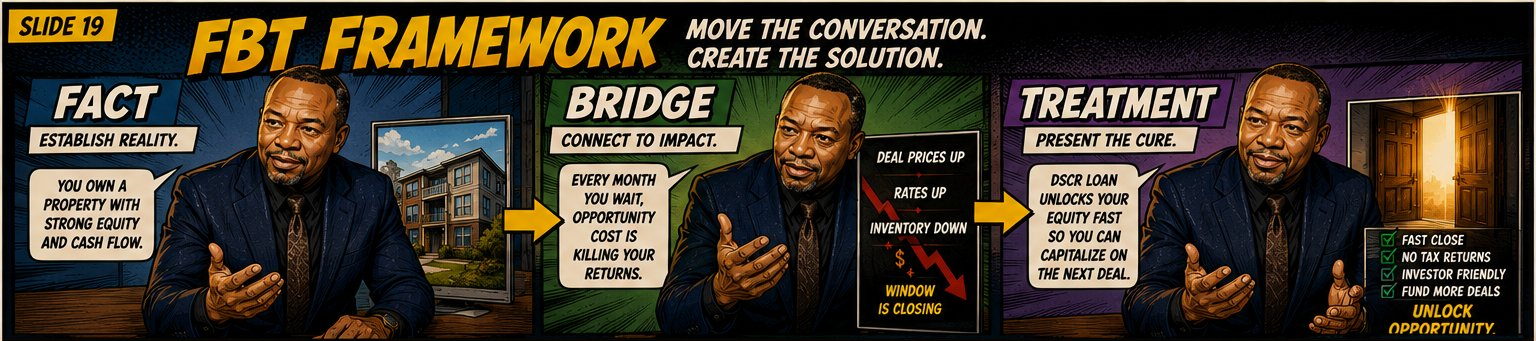
The FBT Tool

Fact → Bridge → Treatment

A simple 3-part frame for turning discovery into the loan recommendation.
Illustration: Fact Bridge Treatment sales path
img/phase3/slide19_fbt.png
F
Fact
Name what is true.
B
Bridge
Connect it to the wound.
T
Treatment
Prescribe the loan as the cure.
Example
Fact: You own the rental free and clear.
Bridge: But the equity is trapped while the next deal is moving.
Treatment: DSCR cash-out unlocks it without tax returns.
Speed pitch

When the pain is delay, pitch speed.

When delay is the wound, speed is the treatment.

If they are running from a bank that dragged them through paperwork, do not lead with rate. Lead with escape.

Terrance "The issue is not that the property does not work. The issue is the bank is making you prove income the wrong way. This route is built to move off the property and rent instead."
Pain: delay. Pitch: speed and simplicity.
Simplicity pitch

When the pain is tax returns, pitch simplicity.

When tax returns are the wound, simplicity is the treatment.

Paper-poor investors do not need another lender telling them they do not qualify because their tax returns are optimized.

Terrance "That is exactly where DSCR fits. We are not asking your tax returns to tell the story. As long as the rent covers the mortgage, the house qualifies itself."
Pain: tax-return rejection. Pitch: the property qualifies itself.
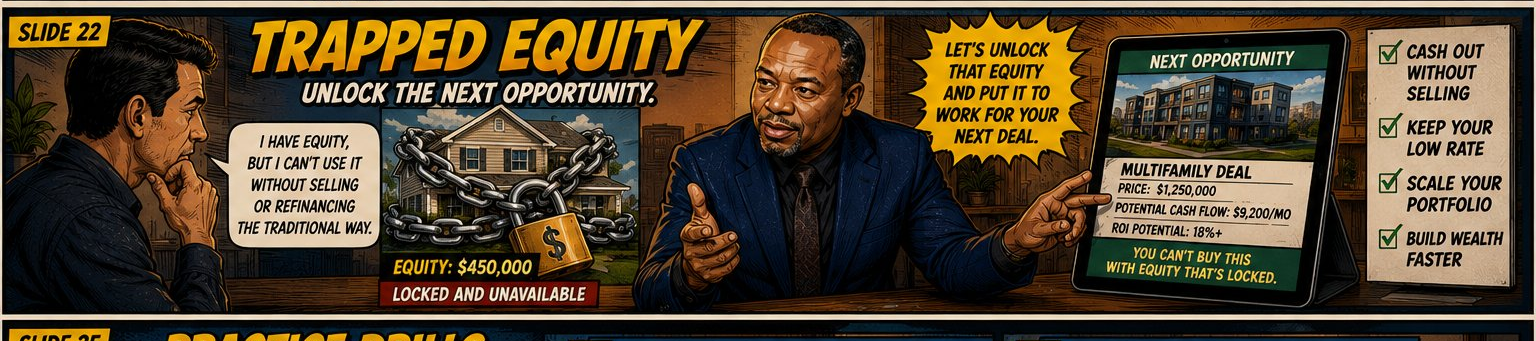
Opportunity pitch

When the pain is missing the next deal, pitch trapped equity.

When missing the next deal is the wound, trapped equity is the treatment.
Illustration: Unlocking trapped equity for the next opportunity
img/phase3/slide22_opportunity.png

Free-and-clear owners often do not need convincing that they have equity. They need help seeing that unused equity has a cost.

Terrance "You already did the hard part — you own the asset. The problem is the cash is trapped inside the property while the next opportunity is moving."
Pain: missed opportunity. Pitch: unlock trapped equity.
Check-in

Match the pain to the pitch.

Prospect says: "Every bank keeps killing me on tax returns because I write everything off."
Best pitch angle?
💊
Prescribe
Do not pitch the product. Prescribe the cure.
Now drill it.
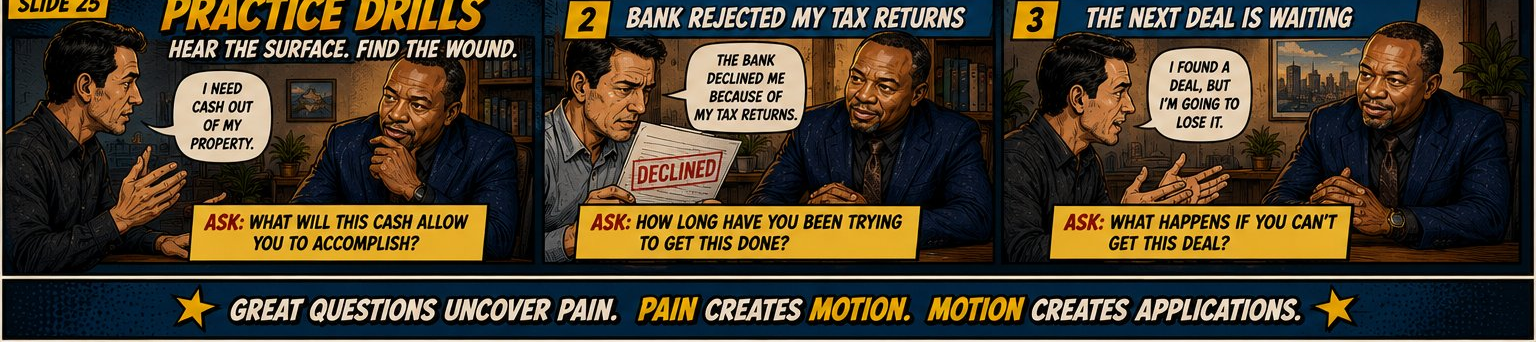
Drills

Hear the surface. Find the wound.

Practice hearing what is said — then asking for what is not said yet.
Illustration: Practice drills for finding the wound
img/phase3/slide25_drills.png

Tap each card after you decide what you would say next.

"I just want to pull some cash out."
Tap to reveal
Move Do not quote yet. Ask what the cash is for.
Line "What are you trying to accomplish with the cash?"
Drill Round 2

Find the pain behind the bank complaint.

"The bank keeps asking for tax returns, but they do not understand I write everything off."
Tap to reveal
Pain Being qualified incorrectly and treated like they are broke.
Pitch "That is exactly why DSCR exists — the rental property tells the story, not your tax returns."
Drill Round 3

Use FBT on a next-deal borrower.

"I found another property, but all my cash is tied up in my rentals."
Tap to reveal
Fact "You already have equity sitting inside the rental."
Bridge "But it is trapped while this next deal is moving."
Treatment "A DSCR cash-out unlocks that equity so you can move without waiting on a bank tax-return approval."
Drill Round 4

Do not accept "perfect" from yourself.

Prospect says: "I've been trying to get this done for months."
What should you say next?
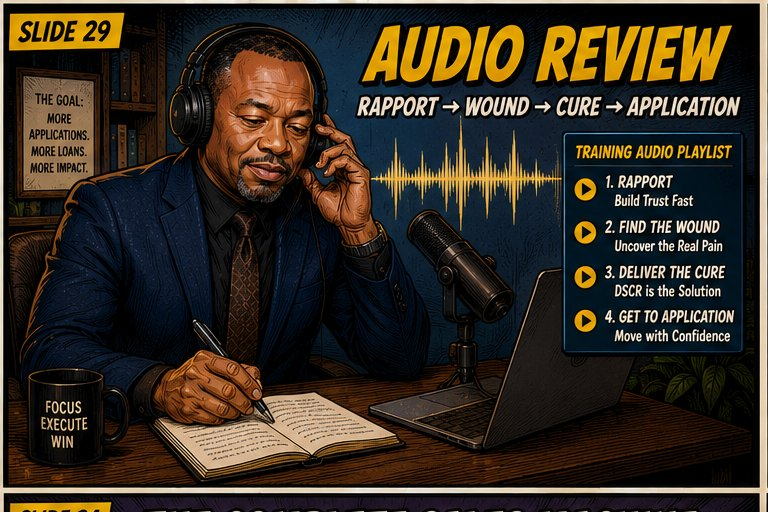
🎧

Listen to the full Phase 3 breakdown.

Listen for the sequence: rapport → wound → cure → application.
Illustration: Terrance recording or listening to Phase 3 audio
img/phase3/slide29_audio.png

Audio should reinforce rapport versus pain, one-more-question, Problem and Implication questions, FBT, and how Phase 3 connects to Phase 1 and Phase 2.

▶ Audio placeholder
Recap

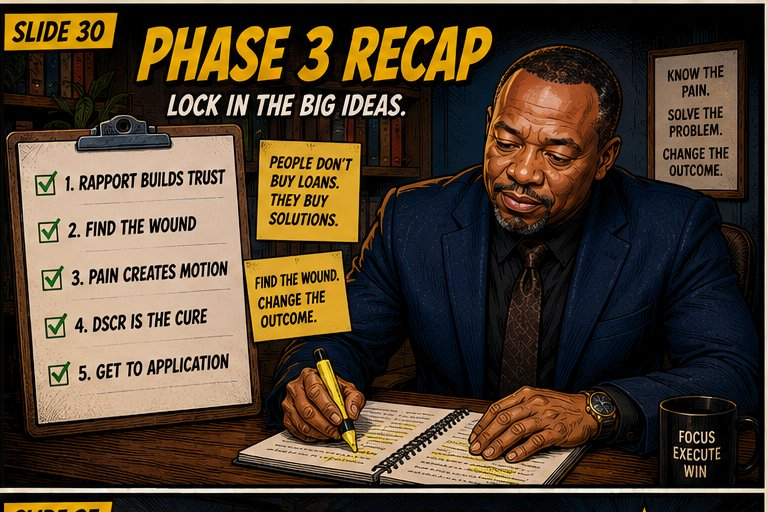
The wound.

Lock the big idea before the full machine.
Illustration: Terrance reviewing the Phase 3 recap
img/phase3/slide30_recap.png
Recap

The dig.

This is the behavior change: question before "perfect."
Recap

FBT turns pain into pitch.

Use FBT when you are ready to pitch from pain.
F
Fact
Name what is true.
B
Bridge
Connect that fact to the wound.
T
Treatment
Prescribe the cure.
Recap

What changes now.

This is how Terrance's call control changes after Phase 3.

You are not just building rapport. You are diagnosing.

You are not just collecting file facts. You are finding the consequence.

You are not just explaining DSCR. You are prescribing speed, simplicity, or access to trapped equity based on what hurts.

The better the wound, the cleaner the close.
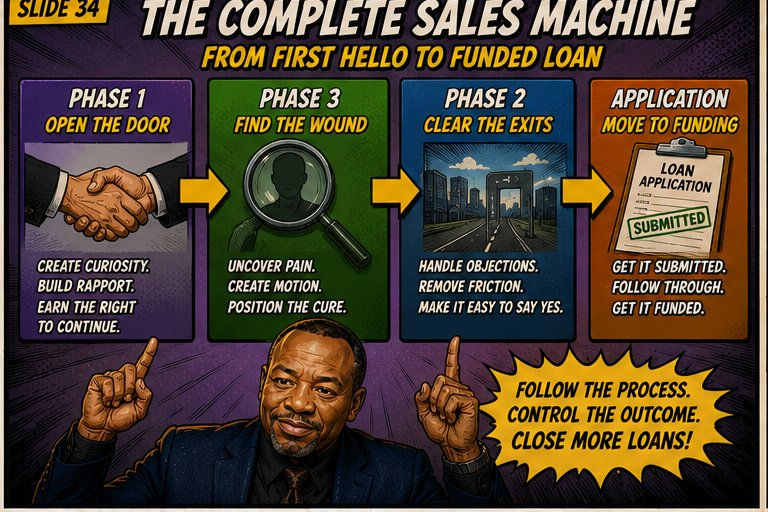
The Machine

The whole machine — from first resistance to submitted application.

All three phases are one call system, not separate lessons.
Illustration: Cross-phase sales machine from resistance to application
img/phase3/slide34_cross_phase_machine.png

Every tool has a moment. Every phase has a job.

1
Phase 1Open the call
Build trust and take control.
2
Phase 1Handle the brick wall
Use ARP when they demand rate, terms, or one quick answer too early.
3
Phase 3Find the wound
Ask Problem and Implication questions until you know what happens if they do not solve this.
4
Phase 2Pre-empt the hidden no
Use PUO: "If everything makes sense, is there any reason you would not move forward today?"
5
Phase 3Pitch the cure
Use FBT: Fact → Bridge → Treatment.
6
Phase 2Clear the exit
If they stall, use ARC. Do not accept "let me think about it."
7
Phase 2Phase 3Pre-frame the money
Explain the fee frame before the quote lands.
8
Phase 3Ask for the application
Do not end with "look it over." End with the application.
Phase 1 opens the door. Phase 3 finds the wound. Phase 2 clears the exits. This is the whole machine — and it ends with an application, every time.
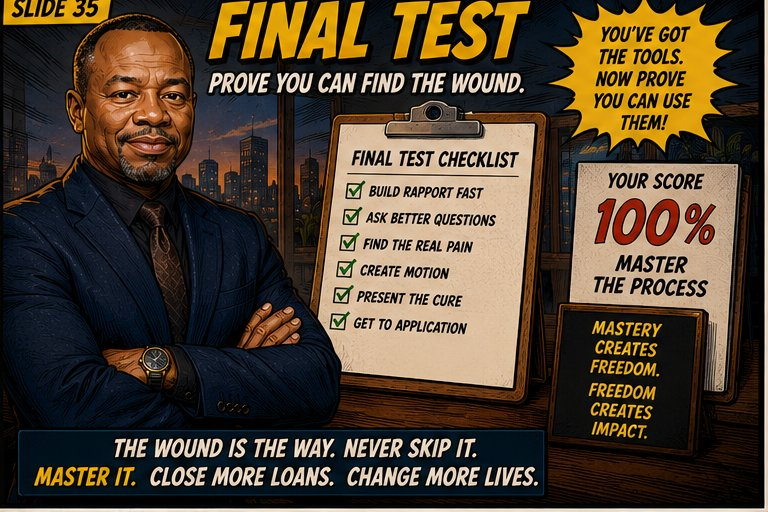
The Funding Clinic — Phase 3 Test

Prove you can find the wound.

Illustration: Final Phase 3 mastery test
img/phase3/slide35_final_test.png

Three short-answer questions. Score 4 or higher plus two follow-up challenges each.

Progress
0 of 3 complete
1
A prospect says, "I want to pull some cash out of my rental." What is the surface statement, what wound are you looking for, and what is your next question?
Separate the request from the consequence.
2
Use FBT for this scenario: "I found another property, but all my cash is tied up in my current rental."
Give the Fact, Bridge, and Treatment.
🔒 Unlocks after Question 1 and both follow-ups
3
Walk through the whole machine. Where do Phase 1, Phase 2, and Phase 3 each fit in the call?
Use the door / wound / exits language.
🔒 Unlocks after Question 2 and both follow-ups
All three complete. Get your result.
📋 My notes
Jump to